
BluNode’s Mission
BluNode engineers megawatt-class power delivery architecture for AI-scale computing. As rack demand climbs from today’s kilowatts toward the megawatt range, we design the power shelves, energy storage, and high-voltage DC distribution systems built to keep pace with that curve. Whether a data center operator standardizes on 800 VDC bipolar or monopolar topology, BluNode delivers top-tier power sidecar racks and service for clients. Our mission is to give data center operators the power infrastructure to meet tomorrow’s workloads, not just today’s.
Problems that Created BluNode
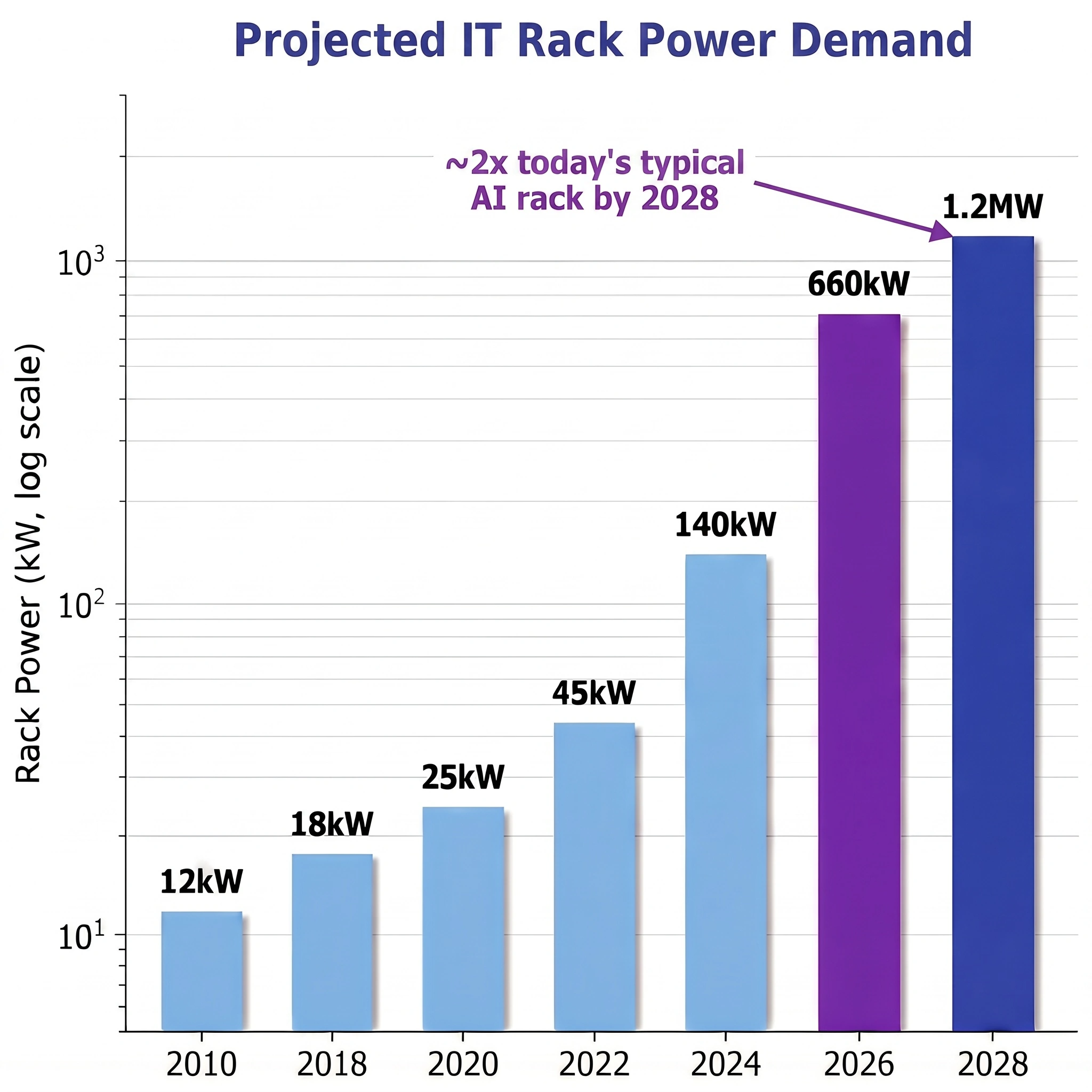
AI compute is scaling faster than the power infrastructure built to run it. A single AI server rack is projected to demand roughly 1.2 megawatts by 2028 — nearly 10x today’s draw. That growth breaks legacy data center power architecture: copper busbars are hitting their physical limits, per-tray power supplies are out of room to scale, and power itself is becoming the real bottleneck to AI infrastructure growth. Legacy power equipment wasn’t built for this curve, and it’s running out of runway fast. BluNode exists to close that gap — engineering the power architecture built for where AI compute is going, not where it’s been.
Solutions BluNode Provides
Compute density has outrun power density, and the gap widens with every generation. Data centers can’t afford to wait for one sweeping rip-and-replace overhaul, and they can’t keep building on an architecture that’s already maxed out. BluNode closes that gap without forcing the choice: our megawatt-scale sidecar racks slot into the power path data centers run today, sized for the load they’ll carry tomorrow — a scalable step forward, not a bet on tearing everything out. The window to act is now, and BluNode is built for it.
BluNode’s Solutions:
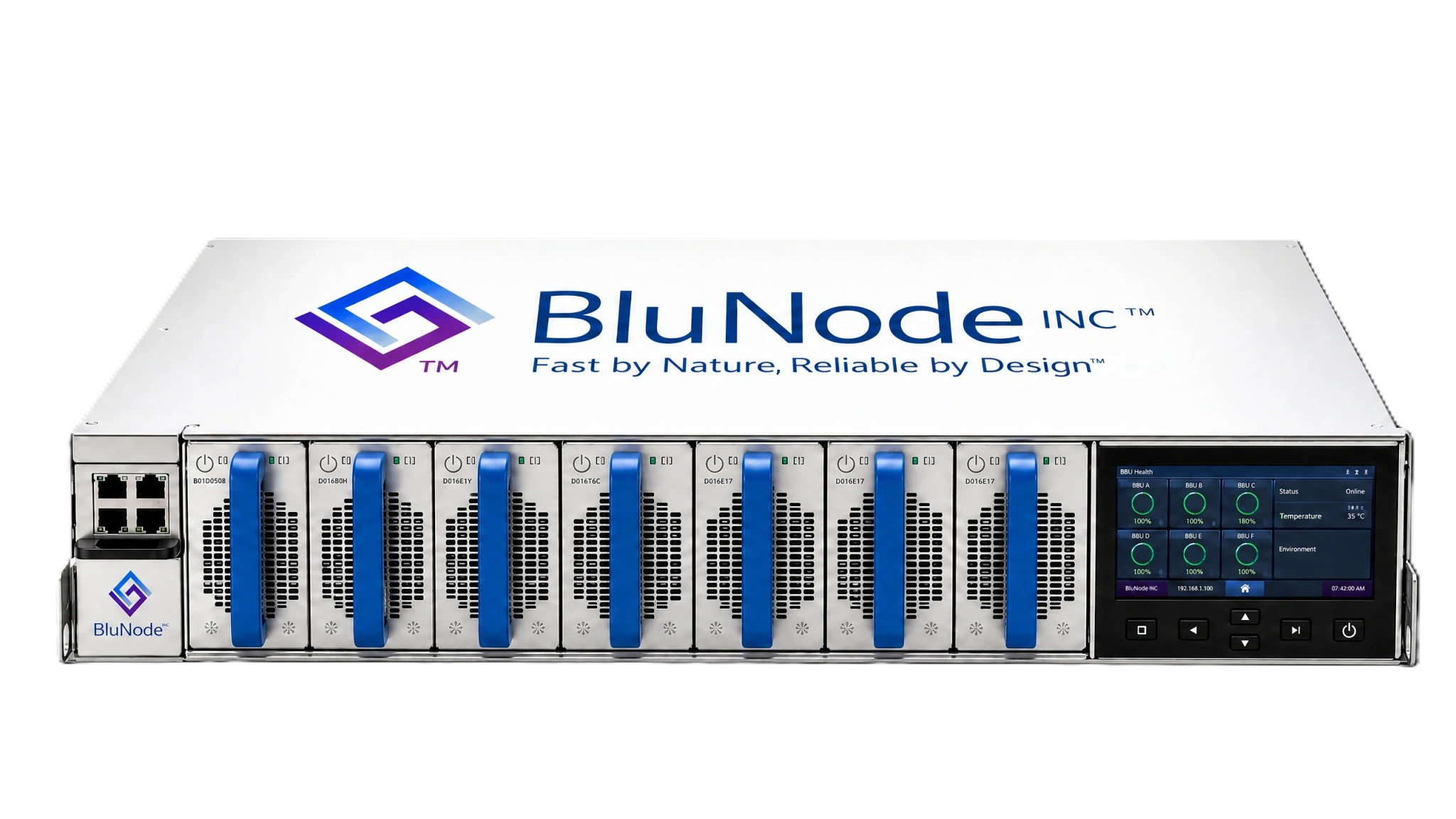
Bi-Polar 800VDC Architecture
Coming Soon 2028
Gen 3 takes power conversion off the rack entirely. As AI racks push toward and beyond 1 MW, BluNode’s external sidecar pulls 480V AC straight from the facility grid, converts it to a bipolar ±400V DC bus, and distributes it to adjacent IT racks — housing battery backup along the way and freeing up rack space for what actually matters: compute. The bipolar topology doesn’t just cut losses — it builds in redundancy a single monopolar bus can’t offer. Loads connect pole-to-neutral at 400V or pole-to-pole across the full 800V differential, so a fault on one rail leaves the other pole live. The current math backs it up: a megawatt-class load on a single 400V pole draws roughly 2,500A, versus ~20,000A on a legacy 50V bus — an 8x cut in current and busbar copper. Loads spanning the full 800V differential see the full reduction: 16x, down to ~1,250A. Each IT tray then steps the HVDC bus down locally to 48V, 12V, or 6V, exactly where it’s needed. Move conversion off the rack, keep rail-level redundancy, and the payoff is more usable compute density without sacrificing fault tolerance — built for AI racks running tightly packed processors over high-density interconnects.
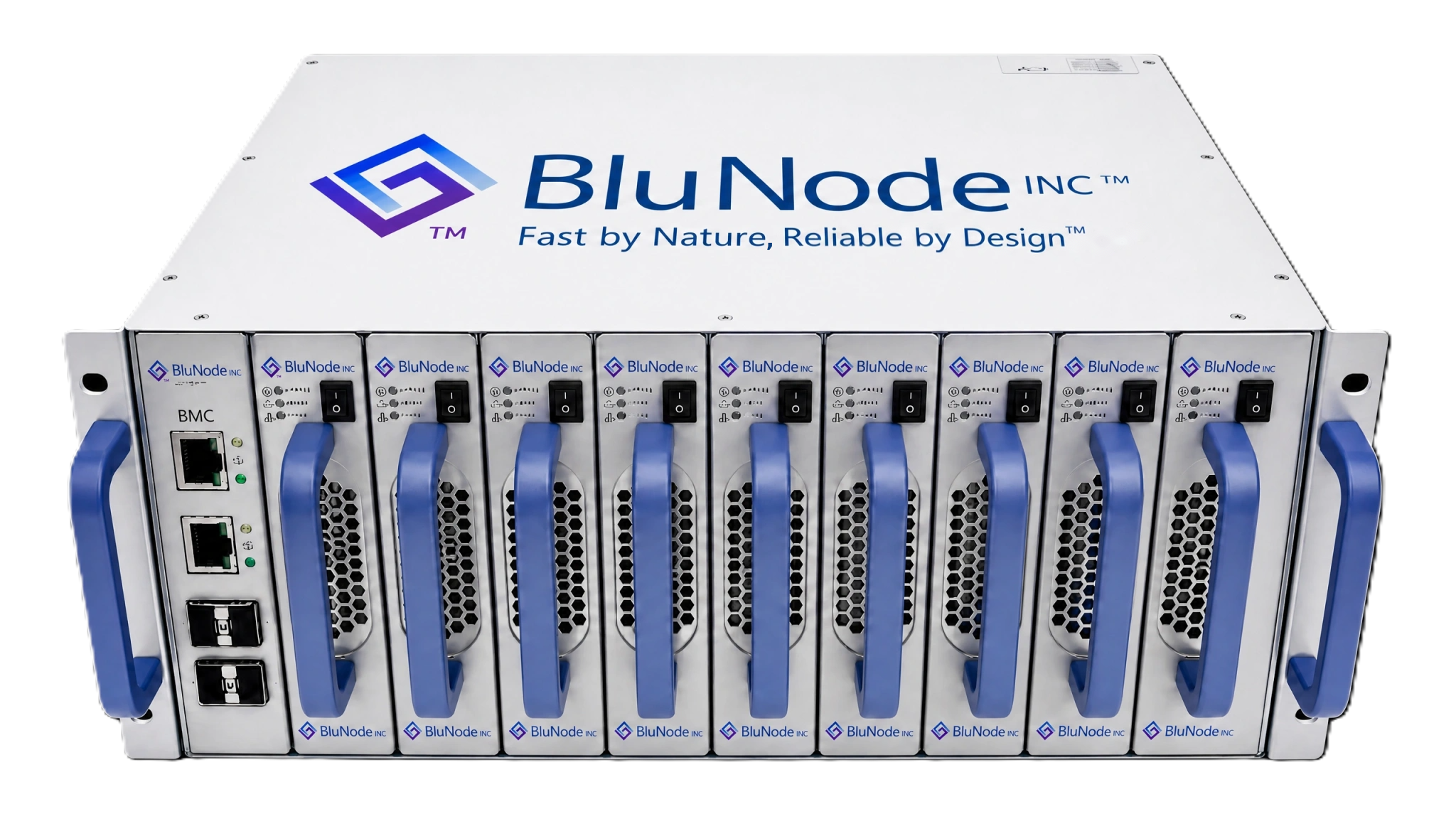
Mono-polar 800 VDC Architecture
Coming Soon 2028
Gen 3 takes power conversion off the rack entirely. As AI racks push toward and beyond 1 MW, BluNode’s external sidecar pulls 480V AC straight from the facility grid, converts it to a single 800V DC bus, and distributes it to adjacent IT racks — housing battery backup along the way and freeing up rack space for what actually matters: compute. The monopolar topology gets the full efficiency gain out of a single high-voltage rail. Raising distribution voltage from 50V to 800V cuts current — and busbar copper — by roughly 16x: a megawatt-class load needs ~20,000A on a legacy 50V bus but only ~1,250A at 800V DC, enabling a lighter, more efficient busbar than a split-rail approach can match at equivalent power. Each IT tray then steps the HVDC bus down locally to 48V, 12V, or 6V, exactly where it’s needed. Move conversion off the rack, consolidate distribution onto a single high-voltage bus, and the payoff is more usable compute density with a simpler busbar and converter design than a bipolar system requires — built for AI racks running tightly packed processors over high-density interconnects.
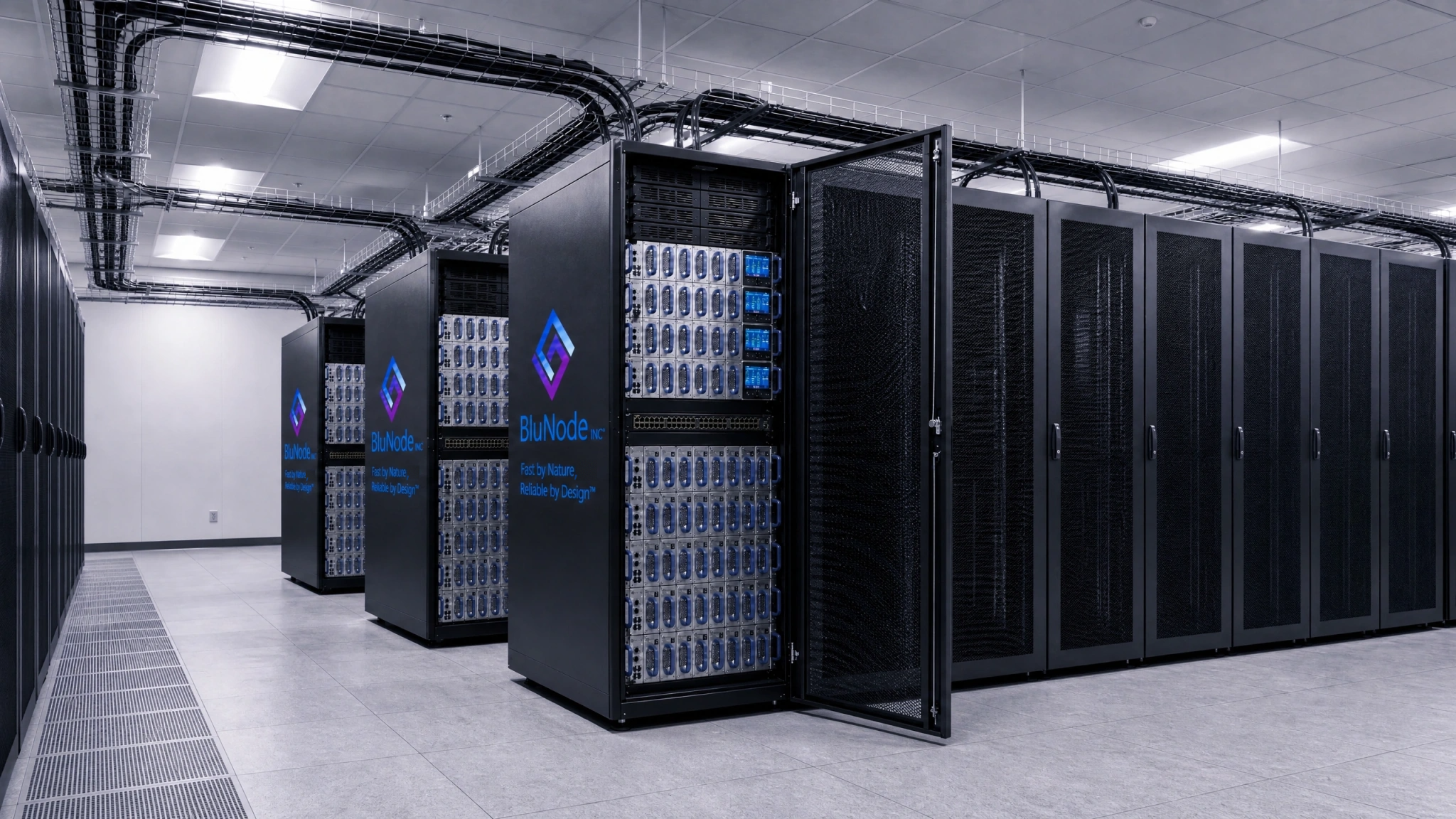
AI power racks and megawatt power sidecars
BluNode Inc designs AI power solutions for data centers whose racks are outgrowing legacy power. The lineup covers AI power racks and external AI power sidecars: 800VDC ORv3 power shelves, 800VDC battery backup units, and megawatt-class sidecar racks in both bipolar and monopolar topologies.
These next-generation power solutions are for hyperscale data centers and other AI facilities planning megawatt power racks. A sidecar takes 480V AC from the facility grid, converts it to 800V DC, and feeds adjacent IT racks. That gives high-density GPU systems, including racks built on next-generation NVIDIA GPUs and other AI accelerators, a path toward and beyond one megawatt without replacing the whole data hall. The initial product launch is 2028.
Teams comparing power sidecars for AI racks can use the bipolar rack when they want rail-level redundancy, or the monopolar rack when they want one 800V bus and a simpler converter design.
Common questions about BluNode power
What is BluNode Inc?
BluNode Inc is the company behind BluNode at blunodecorp.com. From Dallas, Texas, BluNode engineers megawatt-class power delivery for AI-scale computing, including power shelves, battery backup, and high-voltage DC distribution.
What AI power racks and power sidecars does BluNode build?
BluNode builds 800VDC ORv3 power shelves, 800VDC ORv3 battery backup units, and external megawatt-class sidecar racks. Bipolar sidecars deliver a ±400V DC bus. Monopolar sidecars deliver a single 800V DC bus. Both house battery backup outside the compute rack. Availability is planned for 2028.
Are BluNode power solutions meant for hyperscale data centers?
Yes. The architecture is for data center operators standardizing on 800VDC, including hyperscale sites preparing for AI racks that draw toward roughly 1.2 megawatts. Sidecar racks slot into the power path a hall already runs, sized for the higher load.
How does this architecture relate to next-generation GPU racks?
BluNode moves power conversion off the IT rack. That frees rack space for compute and cuts busbar current sharply versus legacy 50V distribution. The 800VDC design targets high-density GPU racks, including next-generation NVIDIA-class AI systems that need megawatt-scale power delivery.
How do I contact BluNode about a power project?
Contact BluNode Inc at info@blunodecorp.com or through the contact page. Headquarters are in Dallas, Texas, and the initial product launch is set for 2028.